← Previous Module Next Module →
The Sustainable Finance Policy Guidance is underpinned by eight core principles that aim to guide the development of a robust sustainable finance policy framework at the national level. The overarching goal is to mainstream sustainability into the capital market and leverage sustainable finance for investment in sustainable development. The principles draw on the latest developments and best practices in sustainable finance regulation and policymaking in both developed and developing economies, prioritizing practicality and operationalization of sustainable finance regulation at the national level.
- A. Scope and objectives of the principles
The principles aim to rationalize policymaking in the field of sustainable finance into a set of “design criteria” that can help address the challenges facing policymakers as discussed in the introduction. In particular, the principles are designed to address the need to integrate sustainable finance in national development strategies, ensure policy coherence, promote market transparency and credibility, create multi-stakeholder synergy through an investment chain approach, and encourage international coordination on investment-related challenges, following a science-based and forward-looking approach.
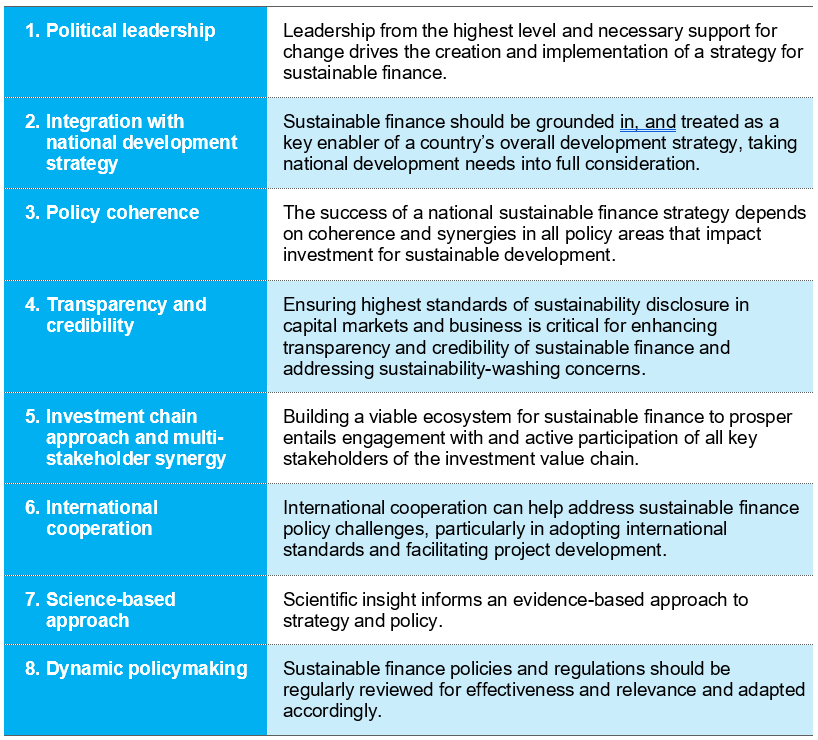
The principles intend to provide a framework that provides guidance for policymakers and regulators in developing an integrated set of action lines for sustainable finance policymaking. The eight principles are:
![Principles]()
- B. Annotations to the Principles
Political leadership
National leaders have a key role to play in setting the right conditions to both create and then advance a national strategy on sustainable finance that is in harmony with existing national carbon reduction targets and strategies. It is important to state and explain the role of sustainable finance for the future of the national economy. Such statements and expectations should be reinforced by the provision of necessary resources and the mobilization of all stakeholders. This can be done best with a national strategy developed with the support of political leadership at the highest level.
Political leadership is also key to mobilizing the public sector. Public institutions should be the first movers due to their size and resources and the need to align of their mandates with the goals and objectives of sustainable and inclusive development when delivering public goods. The response to the Covid pandemic shows that government agencies are capable of swift and decisive action, and this “proof of concept” should also be applied to rolling out effective policy on sustainable finance. Institutional capacity and effective of coordination and harmonization across institutions is critical in this respect.
With regards to financial markets, the public sector is also an important market participant on both the supply and demand sides. As such, public institutions can drive sustainable finance forward, and both national and regional governments can demonstrate leadership here. Even pending the publication of new regulations, the public sector can make innovative changes to its sustainability performance and practices.
2. Integration with the national development strategy
The national strategy for sustainable finance should be founded on and contribute to the achievement of the overall development strategy. A latest development in this context, countries are increasingly aligning their national sustainable finance strategies with national objectives in a country's overall SDG strategy and the Paris Agreement, including Nationally Determined Contributions (NDCs) and National Adaptation Plans (NAPs) under the United Nations Framework Convention on Climate Change (UNFCCC) can serve as the starting point and guiding framework for the development of a national sustainable finance strategy.
Such strategies can ensure the adoption of a systematic approach, and help establish policy objectives, priorities and key areas for actions to provide guidance and stimulate national efforts to support the growth of sustainable finance. Meanwhile, by aligning with the overall SDGs and climate commitments, the national strategy for sustainable finance can identify financing needs and prioritize actions to support sustainable development objectives.
Key elements of such a strategy include articulating a clear vision with well-defined goals and a timeline for action, clarifying responsibilities of stakeholders, and allowing for regular updates to adapt to social, economic, and environmental progress. The identification of priority action areas should align with the national development strategy and address urgent development needs, such as social inclusion, education, healthcare, SME development, and environmental risks to agriculture and food security, while fully considering the national development context.
3. Policy coherence
Sustainable finance is not an isolated endeavor, but a means to an end. The effectiveness of sustainable finance policy relies on achieving coherence across a spectrum of interconnected policy areas, spanning from investment and technology to energy and industrial policies. These policy domains interact and necessitate a comprehensive approach to foster sustainable development and unlock synergies.
International practices have shown that an effective strategy for sustainable finance requires policy changes across all relevant areas, particularly in financial, fiscal, industry, technology, and social policies (PRI, 2022). Addressing policy inconsistencies is essential to ensure success. For instance, to finance the energy transition successfully, it becomes imperative to phase out fossil fuel subsidies, which currently amount to $1 trillion globally—eight times the value of subsidies for renewable energy (UNCTAD, 2023).
Another critical aspect of policy coherence involves harmonizing industry standards, such as investment product definitions and disclosure requirements. Countries should draw upon international standards and best practices, acknowledging that policy coherence extends to the interaction between national and international rulemaking.
To ensure policy coherence, successful experiences often involved the creation of a national coordination mechanism, headed by a leading government body and with a specific mandate to coordinate the work of different ministries, government units and policy areas. This coordination fosters a holistic and collaborative approach to financing sustainable development, and is essential for the growth of sustainable finance.
4. Transparency and credibility
A fundamental challenge for further growth of sustainable finance remains the quality assurance of markets and products to minimize greenwashing and any backlash associated with it. According to UNCTAD’s analysis, at least a quarter of sustainable funds may not meet their sustainability credentials (UNCTAD, 2023).
The best solution to greenwashing is to enhance transparency through expanded and improved disclosure, at both company and product levels and also in sustainability ratings. Transparency is essential for investors and regulators to make informed decisions about their investments and regulatory measures. Among all sustainable finance measures adopted at the national level, nearly half are about sustainability disclosure. However, many of these measures are voluntary, fragmented, and often overlook small and medium-sized enterprises (SMEs) and disclosure requirements for sustainable investment products.
An ideal approach involves making sustainability disclosure mandatory and extending it to encompass sustainable investment products, sustainability ratings, and SMEs. Although SMEs are currently exempted from sustainability disclosure in most economies, they will eventually be demanded by multinationals to report on sustainability to be part of their supply chains. It is important to help them to develop necessary capacities and formalize their sustainability disclosure responsibility once the conditions become mature.
Sustainability disclosure regulation also need to take the latest development in international standards into full consideration. In particular, in view of the emergence of the International Sustainability Standard Board standards (standard S1 on general sustainability and S2 on climate disclosure) as a global baseline for sustainability disclosure, efforts should be made to align with the ISSB standards with necessary adaptions required by the local context, which is allowed by the design of the standards, provided that the local provisions do not obscure information required (UNCTAD 2023).
5. Investment chain approach and multi-stakeholder synergy
The path to sustainable finance lies in embracing an inclusive multi-stakeholder approach. This approach necessitates engaging all key stakeholders and clarifying their roles and responsibilities, aiming to establish a robust ecosystem for sustainable investment to flourish. It also involves actively engaging civil society in policy-making processes to ensure policy transparency and garner public support.
Implementing sustainable finance policies will drive comprehensive changes that affect all economic activities. Recognizing this, it is vital to embrace transformation in the financial system by incorporating sustainability risks and opportunities across relevant respects of banking, insurance, market practices for making investment decision, credit and sustainability rating, and crucial market infrastructure such as stock exchanges.
Financial regulators will need sufficient and clearly defined mandates to drive sustainability integration in capital markets. These mandates should go beyond merely ensuring a stable market; they should encompass the implementation of necessary policy and regulatory measures to channel sustainable credit and investment flows towards socially and environmentally desirable activities.
Furthermore, the success of sustainable finance policies and regulations also hinges on the capacities of financial market participants and corporations that form the productive economy. It is important to provide necessary support and set clear expectations for financial institutions and corporates to make investment in relevant capacities, in particular in sustainability disclosure and compliance with regulations and standards.
6. International cooperation
Sustainable finance has largely bypassed the developing world so far, as evidenced by the extremely low investment flows to developing economies, except for the largest ones. Most developing economies, especially the least developed ones, face tremendous barriers to establishing their own sustainable finance market or benefiting from the international market, owing to lack of readily available projects or financial instruments, scarceness of high-quality data, and related perceptions of high risks.
Ensuring adequate standards and disclosure requirements by aligning with international standards can help mitigate these issues, and international support in capacity building in related areas may be needed in many developing economies. Meanwhile, international development finance institutions and developing economies can assist developing economies in project development through blended finance, investment insurance, or capacity building.
Drawing from the experiences of ASEAN, regional collaboration can also play an instrumental role in bolstering sustainable finance in developing economies. By harmonizing regulations and standards at the regional level and developing standardized sustainable investment products, developing economies can attract both local and international investors.
7. Science-based approach
Science-based decision making is essential as national economies transition to a more sustainable future. A science-based approach in sustainable finance decision requires an appropriate framing of sustainability problems, such as the inalienable link between economic activity and environmental impact, and clearly defined goals based on scientific evidence.
Such an approach also requires taking latest development in science and technology as well as national development context into consideration when defining solutions to sustainability challenges and developing relevant technical standards to define and classify economic activities that are considered environmentally sustainable, as many countries did in developing their green taxonomies.
The importance of the science-based approach also lies in its ability to promote transparency, comparability, and credibility in the financial market. In particular, by providing a standardized framework for assessing and labeling environmentally sustainable activities, a science-based taxonomy can help investors, businesses, and consumers make informed decisions that align with sustainable development goals. It reduces the risk of greenwashing, which is the misleading or exaggerated claim of environmental benefits by certain products or activities. It encourages businesses to transition towards sustainable practices, thereby driving innovation, job creation, and economic growth in sectors that contribute to a greener and more resilient future.
As revealed by EU’s experience, granular and calibrated technical screening criteria are needed to establish the minimum requirements for sustainability for the different economic activities. Given the specific technical details needed to assess the environmental impact of an economic activity and the fast-changing nature of both science and technology, these criteria for environmentally sustainable economic activities should be adapted regularly to reflect such changes. In the case of the EU, relevant regulation requires that the technical screening criteria be reviewed at least every three years.
8. Dynamic policymaking
National sustainable finance policies need flexibility to adapt to changing circumstances, while recognizing policy stability and predictability. This is especially important since sustainable finance remains at a relatively early development stage in many countries, and the financial and technological landscape is rapidly evolving. As a result, policy measures and regulations need to be reviewed regularly, and revised whenever needed due to changes in internal or external conditions (such as the introduction of new international standards).
Furthermore, countries may need to tailor their policy measures and regulations to different stages of development. Developing economies, in particular, may need to carefully sequence their policymaking based on the maturity of their financial markets and the capacities of regulators, market participants, and other stakeholders. For example, capacity building support could be needed before implementation of certain measures or standards.
A further aspect of dynamic policymaking is to make good use of forward-looking scenarios, in terms of technology advancements and sustainability requirements, with an emphasis on impact and outcomes. Making use of such forward-looking tools can help to “future proof” policy, adopt measures and high-level standards catering to future needs, and thus prevent policies from becoming outdated quickly.
In addition, policies and regulations will need adjustment where individual measures, entire policy areas, or the overall sustainable finance strategies are deemed not to achieve the intended objectives, or to do so at a cost higher than intended. Understanding when this is the case and taking timely corrective actions is the essence of effectiveness for policymaking.